
Edition #187: Macro failures, plateau freedom, and refeed days
Mar 13, 2026
Welcome to 1-3-1 Fridays, my weekly newsletter, where I reveal evidence-based strategies to get lean, strong, and create optimal health.
You'll receive one personal health insight, three actionable tips, and one concrete action step. Let's dive in.
Here's what's new this week:
- Ep 16: Chemicals, toxins, and heavy metals | environmental health design (Podcast)
- Her life never went back the same | Michele Olender
(YouTube)
March 23rd kicks off our next spring challenge.
If you want to drop 4-8 pounds or build 2-4 pounds of muscle in minimal time over the next 30 days, this is your opportunity.
Get strong, lean, and confident while kicking off spring in your best health.
What's in store for today:
- Why macro calculations will ultimately fail and how to win in your nutrition.
- The inevitable plateaus that slow down progress and how to break through with ease.
- How to use higher-calorie days when dieting, and my suggested approach to keep things simple.
I spoke with 2 plant based physicians last week.
One a naturopathic MD.
Another a plant based allopathic doctor.
Both shared similar sentiments:
Health is built by your lifestyle.
Or another way of saying this - it's built by your daily choices.
Health isn't built overnight. But it does happen every day.
So after recording both of these new episodes for the VBL Podcast, I'm reflecting on what I've learned so far.
According to research, a whole-food plant-based diet is the most optimal for lifelong health.
This is supported by decades of concrete evidence, including the largest human studies recorded.
But health is also multifactorial.
Something as chronic and debilitating as Type 2 diabetes can actually be cured and healed using the right plant-based approach.
That's incredible.
But health is layered with our physical, mental, and emotional domains too.
So mastery in each area brings you one step closer to a unified system of health.
Unfortunately, we live in a world of charlatans.
The world feeds off its own ignorance.
It's the classical ouroboros: the snake eating its own tail.

We keep reliving our cyclical patterns of suffering (internal and external tension) until we're exhausted.
But you can change.
Or as Buckminster Fuller said:
Health comes down to your daily choices.
Your daily choices come down to your level of understanding.
The better your model of health is to start from, the better your health becomes.
Plant the right seeds.
Then, water them every day.
Lesson: When you start with health as your foundation, everything shifts.
Here's Your 1-3-1 Friday:
1.) Macro 'failures'
Ever fail with your macros?
It's happened to me plenty of times. Many of our clients share similar experiences.
Greg Nuckols is one of the world's leading experts in exercise and nutrition science.
His team has also built one of the best macro tracking apps that uses a similar reasoning model.
We've been working on a brand-new macro calculator for the past few months, and we're making it 100% free for everyone.
It's still a work in progress.
What I really like about our calculator is that it sets us apart from 99% of macro calculators online: we use the upgraded BMR models based on Nuckol's formulas to account for metabolic adaptation.
This combination makes our tool unique and effective.
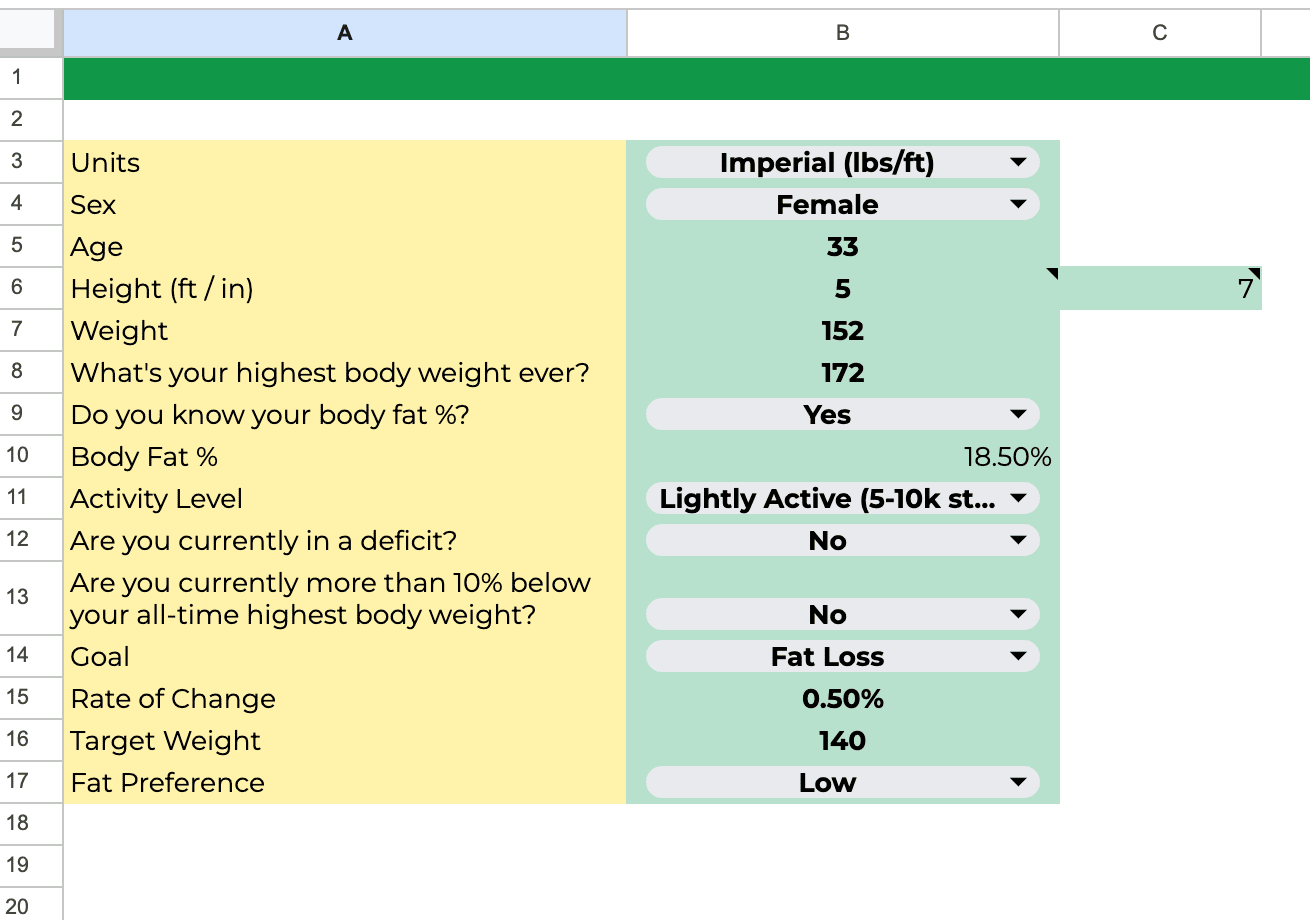
New macro calculator project. :)
Metabolic adaptation is part of the fitness game.
Your body adapts to your exercise and diet. Over time, these methods may lose their effectiveness.
If you have stayed in a deficit for a while (more people than you would expect, especially women) or are below 10% of your all-time highest bodyweight, there is a higher possibility you may be experiencing metabolic adaptation.
If that's the case, our free calculator will make sure it covers your bases for either situation.
It's still not perfect.
I doubt any calculator will ever be perfect, since the human body has many nuances and changes daily.
Still, this is one of the closest models that will work.
Here's a quick summary from this other article where Greg discusses how weight loss affects BMR.
Exercise and nutrition aren't separate in body transformation. They work together in a web that affects our health.
If you want to stop macro 'failures' once and for all, note down Greg's insights and the physiological changes that occur when you drop calories.
Here's Greg's recap:
- Your BMR will likely decrease as you lose weight. However, most of that decrease is simply due to losses in body tissue. It takes less energy to power a smaller body.
- Preserving fat-free mass by losing weight gradually, exercising (especially resistance training), and eating plenty of protein will help you lose more fat and less fat-free mass, thereby mitigating reductions in BMR.
- Metabolic adaptation – reductions in BMR in excess of what you’d predict based on the magnitude and composition of the tissue you lose – is a normal part of weight loss.
- Metabolic adaptation of about 5-10% is pretty typical. More metabolic adaptation is generally seen with greater total weight loss and faster rates of weight loss.
- Reducing your rate of weight loss can help mitigate metabolic adaptation. Smaller consistent energy deficits and intermittent dieting strategies seem to be similarly effective at reducing metabolic adaptation.
- Metabolic adaptation mostly resolves when you return to maintenance, and your weight stabilizes. Though a slight metabolic adaptation may persist – around 3-5% seems typical (which usually amounts to less than 100 Calories per day)- many studies report that it goes away entirely.
Again, absorb what's useful, leave the rest, and focus on what matters to you.
2.) Create plateau freedom
The most frustrating part about fitness?
The inevitable plateaus.
It's even harder when you're working out, eating well, and tracking your steps.
Plataus are part of the process.
Staying stuck doesn't need to be.
Here's how you can make it work this time:
- Track your data, especially in the first 3 weeks. Fluctuations will occur in either direction (for fat loss or muscle building).
- Learn to decipher trends vs fluctuations. Fluctuations happen on a daily basis, and trends reveal themselves over time (1-2 weeks).
- Plateaus are inevitable parts of the process, but they don't always mean something is wrong. It's an opportunity to test, evaluate, and refine.
For fat loss, expect water weight loss. This can be 3-4 pounds out of the gate or 3 weeks down the line. But it will happen.
Sometimes your body retains water weight (more common in women), so be prepared to stay patient if that is the case.
For muscle building, you may gain 3-4 pounds (mainly water weight, especially with higher carbohydrate intake). Again, this can happen right out of the gate or a few weeks down the line.
Get ready, both mentally and emotionally, for these ups and downs. Keep an eye on your results like a curious scientist.
I recorded an in-depth episode on plateaus here if you'd like to listen.
3.) Using high/low-calorie days
Some of you might be familiar with high or low-calorie days.
They've become more commonly shared in the fitness space over the past few years.
They can certainly be helpful.
But they're just another fitness tool in your toolkit.
Context is everything.
Refeeds, or higher-calorie days, aren't very useful for muscle building. There's little evidence that they help with muscle growth.
Refeed days can help with fat loss.
Still, current evidence suggests they may only provide a slight benefit to advanced lifters.
For most people lifting to lose weight, high or low days aren't worth the extra effort.
That said, it can be a psychological break.
If you’ve been in a deficit for a while, it's perfectly fine to have higher-calorie days when you lift and lower-calorie days when you don’t.
Just factor in your weekly calorie target to make sure you're still on track for your fat loss goals.
Example: If your daily deficit puts you at 1,500 k/cal per day, that means you're negative 500 k/cal per day x 7 days = 3,500 k/cal, which averages to 1 pound of fat loss per week.
Your weekly caloric total would be 10,500 k/cal with this current setup.
If you want higher-calorie days when lifting, you could have 1,800 k/cal on lifting days and 1,100 on non-lifting days.
This would still give you the same weekly caloric total of 10,500 k/cal.
So this lets you have more food on days you lift and less on days you don't.
I've used this myself back when bodybuilding, and it was useful at the time.
Looking back, I probably wouldn't use it again.
Health loves simplicity, so if this seems too complicated, it's probably because it is.
If you want to use high/low days, apps like Cronometer let you set this up manually on your end.
But based on working with 100s of clients over the past 8+ years, simpler is better.
That's how you'll create lifelong results in your health.
Do less, better.
1 Action Step
How well has your fitness gone during this winter? What would you change or improve?
One Quote To Finish Your Week Strong
"Perhaps we'll never know how far the path can go, how much a human being can truly achieve, until we realize that the ultimate reward is not a gold medal but the path itself."
- George Leonard
Almost spring here.
Grounding more outside.
Anna planted some veggies last week.
A new season has arrived.
As promised, get leaner on plants in under 5 minutes.
Till next week,

|
Whenever you're ready, there's 3 ways I can help you:
|